Header Random

Saturday, 19 May 2012

Katie Taylor: Boxer, Star, Hero


The viewing figures won't have been impressive, due to the time difference, but the column inches will.  Katie Taylor is again the champion of the world, Ireland's golden girl, and a beacon of hope for us all in a time of economic gloom.

Ten weeks out from London 2012, she has assured her passage to sport's centrepiece not only as the undisputed No. 1 in her weight division, but also as a sports star with increasing global recognition, and more importantly, undoubted respect.  The next three months promise much for Taylor, but her greatest achievement cannot be quantified in medals or trinkets or trophies or even in the adulation of a nation.

Pic: Irish Sports Art


It's less than three years since it was announced that Taylor, and other women boxers, would have the chance to fight for gold in London and the reaction was mixed, at best.  This article from that time shows that there was opposition, within the sport, and ahead of it's return to the Games (women boxed non-competitively in St. Louis in 1904), I would expect many international news outlets to run pieces asking 'is it right?' and 'should women box?' etc.

But not in Ireland.

Here, Katie Taylor has single-handedly made women's boxing an accepted, if not yet a mainstream sport.  Young girls throughout Ireland lace up in clubs each week, inspired by a bone fide hero, and our collective print and broadcast media are enamoured with the woman that inspired them.  Her qualification for the Games was a lead news story on at least one national radio station this week, and not just in the sports bulletins - it is the same today.  When London arrives, we will watch in great numbers and we will cheer Katie on.  We will hope and pray for gold, and undoubtedly welcome her back from London with a gathering previously only seen for the likes of McGuigan, Roche and our soccer stars.

For all Irish people, Katie has answered the question, 'should women box', with a resounding yes.  She's won that argument as convincingly as most of her fights within the ring.  When her skills are witnessed by the wider world in London, I'd wager that she'll convince many more that the IOC were correct in their decision three years ago, and come 2016 the hubbub will be no more.  It's by no means an achievement to rival that of Emmeline Pankhurst, but for women's sport, London will see another barrier broken, with our own golden girl leading the way.

Tuesday, 8 November 2011

Joe Frazier RIP

With today’s untimely death of Smokin’ Joe Frazier, sport itself has lost a true warrior, and one of the most fearsome competitors of all-time.  The 67-year-old has passed away after succumbing to liver cancer overnight.

As a fighter, Frazier had it all.  An Olympic Champion in 1964, he could box as well as brawl, a quality which would define much of his later career.  Frazier’s professional record would be impressive with wins over Muhammad Ali, Jerry Quarry, Oscar Bonavera and Buster Mathis.  His only defeats came twice each to George Foreman and Ali.


Frazier’s battles with ‘The Greatest’ define his career, even though that is something he himself would not be pleased with.  He often spoke of their ongoing animosity, long after their in-ring battles concluded.  Famously, in 1996, after Ali lit the Olympic Torch in Atlanta, Frazier remarked that he wanted to push his rival into the flame.

They first clashed in New York in 1971.  With both men undefeated World Champions at this point, it was the ‘Fight of the Century’ and Frazier would inflict upon Ali the most notable loss of his life, knocking him down in the 15thround en route to a points win.  Ali would win their second contest three years later before the final contest in their trilogy.

The ‘Thrilla in Manila’ is simply 14 rounds of drama.  While Joe Frazier would end up the loser on that balmy morning, above all others this contest would highlight his strongest quality, that enduring spirit.  Even when his eyes were swollen shut, and when his opponent’s jabs would have crushed the will of a weaker man, Frazier kept coming forward and kept fighting on in a brutal war.  Make no mistake; but for the intervention of his trainer Eddie Futch, Frazier would have fought that 15th round, if given the chance, despite the likely disastrous consequences.  It was the event that would shape his very existence for the next 36 years, and in many ways he came across as bitter as a result, but one must remember the disgusting insults levied at him by his opponent in the previous five years.

Ironically, Muhammad Ali has led the tributes to Frazier today, saying “the world has lost a great champion” and that he will “always remember Joe with respect and admiration.”  All boxing fans will do the same – he may have been the third best heavyweight of his era, but he would have been the very best of most decades, and is likely in the top-ten heavyweights of all-time.

Today’s tributes do not match the outpouring of grief which will likely come when his great rival passes away.  However, that love and respect for Ali might just be due to Frazier.  The Greatest only has that title because he was tested and because he had to overcome so many obstacles, none tougher than the man from Philadelphia.

If Muhammad Ali is “King of the World”, then Joe Frazier did more than anyone else to put that crown upon his head.  It’s not the legacy he wanted, or even one he deserved, but it’s enough to cement his place in boxing folklore forever. 

Thursday, 3 November 2011

More Glum Than Glee-ful After Irish Jibes


We may be well into the 21st Century, but this week Ireland is being served an hour of television which appears to have come from the Dark Ages.  Glee is generally regarded as enlightened, hip and forward-thinking, but I’ve found the way it portrays my native land in its latest episode to be either negligent insensitivity or wilful stereotyping.

The latest example of Oirishness, entitled Pot O’Gold aired on Sky One tonight (Thursday) and will appear on TV3 this coming Saturday.  It’s likely going to resonate in this part of the world as it marks the series debut of Damian McGinty, a Derry native who won his spot in the series on a reality TV show.  He plays Rory Flanagan, a newly-arrived exchange student whose brogue is a step removed from Darby O’Gill and has a dress sense taken straight from Emerald City.


Feel free to check off the expected Oirish labels as I go – Rory’s accent, to begin with, was last heard when Cork featured in that episode of Heroes.  The dim Brittany believes he is a leprechaun, and offers her ‘pot of gold’ in exchange for three wishes, one of which involves Lucky Charms cereal.  He’s forced to defend U2, he’s called a potato-eater and even sings Kermit’s Bein’ Green because, guess what, that’s the colour he wears throughout the episode (until the final scene, which features somewhat of a redemption, signified by a new red ensamble).  Watch out for a re-appearance of Seamus McFly’s hat early on as well, among a host of other damning props, insults, jibes and digs all aimed at the Irish nation.  There were no 'tops of the morning' but make no mistake, subversion and irony were not at work here.  This hour of television can be classed as either laziness or casual racism, and was as subtle as a kick in the balls.

Glee is not the only television show to denigrate Ireland in this way in recent times.  Oirishness did not die with The Quiet Man as alcoholics showed in Family Guy, while The Simpsons tried and failed to show a more modern Ireland in In The Name of the Grandfather.  Obama became O’Bama when he visited Moneygall, but it’s not just the Americans who are guilty – Eastenders caused plenty of offence with a trio of Irish-based episodes in 1997 and from personal experience, sweeping generalisations are a regular feature of sports punditry here too.


Having said all this, I genuinely have great time for some aspects of Glee, especially the inclusiveness that it has often shown.  The show has won Gay Media awards for the way in which it portrays homosexuals, and for the way straight characters engage with gay ones.  I’ve also been impressed with the way in which those with physical and (especially) intellectual disabilities are central and equal at McKinley High.  The crude representation of Irish people in this episode belies this, but is not excused as a result.

Great strides have been made in American race-relations in recent years but there is room for further improvement.  Washington DC is home to an African American President, but also a team called the Redskins.  Across the land, sport teams are referred to as Chiefs and Braves and Indians and Seminoles and the Fighting Irish.  Notre Dame's logo is even of a leprechaun in a fist-fight.  Casual racism can become more than that - there is still a lack of black Quarterbacks and coaches, and it’s only eight years since Rush Limbaugh claimed NFL Quarterback Donovan McNabb got an easy ride because of the colour of his skin.  This episode of Glee has provoked little discussion stateside, at least in these terms, so I expect little rancour to emerge there, but in its own way this silence is just as troubling.

I don’t know why it is, but while racism is unacceptable in the Western world, mild forms of it exist in our media to this day.  Sometimes, in Crash or Confederate States of America a spotlight is shone on the problem, but more often than not viewers are served tripe such as Pot O’Gold.  I hope it does not represent the true thinking of those who tune in, but when such stereotyping is so regular, one must wonder why nothing is done.  Are people blind to racism because a colour is not involved?  Is it really acceptable to call an Irishman a potato-eater on television in 2011, 160 years after the Great Famine?  Does society truly tolerate this, because I know that I do not.  In the words of Santana Lopez, in this very show: “It’s mean, it’s bullying and I won’t accept it.”

I look forward to seeing what Irish critics and viewers make of it all.  Tune in to one of it’s many airings in the coming days and form your own opinion. Tweet me on @gavingrace or leave a comment below.

+++

Thanks to Gerard Cunningham for urging me to write this post, and giving me a couple of ideas for it as well.

Saturday, 29 October 2011

Presidential Election Shows TV Still Key In Internet Age

The modern-day world may be one of interconnectivity, of social media and of instant communication, but the 2011 Presidential election has shown that old-style television is still king.


Our case study today is Sean Gallagher, the man who nearly was.  His performance, finishing second in this election, is remarkable in and of itself.  While not necessarily independent, he lacked a party machine for canvassing etc.  He had no posters (at least not on lamp posts) and still was able to get his name out there, thanks primarily to his involvement in the likes of Dragons Den.  He entered the race as a personality, and people warmed to the familiar face.  For a while, at least.

As much as television gave Gallagher a boost, it also took him down.  Monday’s dramatic television debate saw his debate unravel before the nation.  He panicked, froze and showed the people that he is not Presidential, not according to the people of Ireland who left him in droves.  28% of the electorate changedtheir first preference this week, and of those 58% deserted Sean Gallagher.  That is 16.2% of those who voted –he lost out by 11.1%.

Twitter, in particular, is a fantastic way to experience news events, elections chief among them.  Those who followed #aras11 took part in critical discussion, humorous conversation and shared links to some of the most informative (and sometimes ridiculous) columns.  Voters engaged with candidates and their teams in a way that happens on the ground, but not in such an obvious or easy fashion.

However, while twitter is the internet’s brightest point, the reality is it does not have the mass reach of other media.  As of 5:30 on count day, 3800 people had tweeted using the #aras11 hashtag, taking part in this national conversation.  But on Monday night, 900,000 watched the campaign’s most infamous moment in the Frontline studio.  That’s half the amount of total voters.

There are few bigger advocates of twitter than myself, and this is not intended to take anything away from the medium.  However, despite the modern world in which we live, television has again shown it’s hold and power in Ireland.  More than anything else, it can capture, retain and influence the general public.  Ireland is now multi-cultural, modern and the internet is at the fore of our future, but our people remain entrapped by the old reliable television.  This may be 2011, but the story of this Presidential election is an old-style tale. 
In one foul swoop a dragon was slayed and a President crowned, while we all tuned in.

Monday, 17 October 2011

Dan Wheldon RIP

In May of this year, Dan Wheldon was the beneficiary of one of motorsport's most dramatic finishes.


Today, the 33-year-old father of two died in a crash while competing in Las Vegas.

Motorsport.  You never know what's around the corner.

Saturday, 8 October 2011

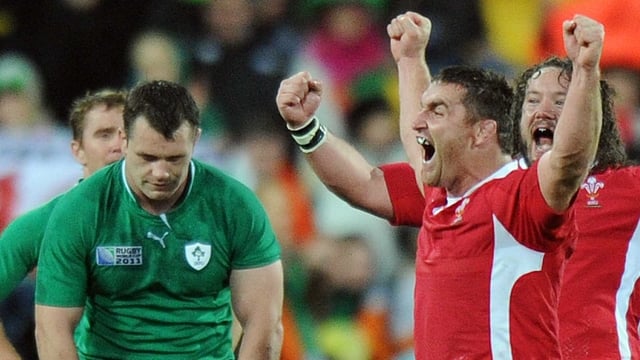
Welsh Loss Set To Haunt Ireland's Greatest Ever Players

Losing’s a bitch.  Losing out on what is probably your last chance must be ten times worse.

As fans of the Irish rugby team, today we hurt.  This morning was a crushing disappointment that we feel even more because it was unexpected, and because of the euphoric highs that preceded it.  Yet as fans, we will have another day, many more in fact.  The Irish people will cheer for us in World Cups in 2015, 2019, 2023 and so on.  Four years is a long time, but time does pass.

But when that happens, things change.  Players get old, some of them too old.  2015 will probably be a bridge to far for the likes of Paul O’Connell, Rory Best, Donnacha O’Callaghan, David Wallace, Gordon D’Arcy and Brian O’Driscoll who by then could be mere fans like the rest of us.  That list is not exhaustive – there may be more, but it may also be the case that some of those men hang on.  I imagine the manner of today’s defeat, and the way it robbed Ireland’s stars of a swansong on the global stage will perhaps induce second thoughts and a drive to continue.


Some will go however, perhaps not straight away, but they will.  The Ireland team of the 2012 and 2013 Six Nations will look very different to the all-too-familiar squad of recent times.  It’s still too soon for a post-mortem, when we don’t even know who is leaving, but when change is most certainly coming, one thing has to be said – today is the most disappointing day any one of them will have experienced in an Irish jersey.
We have lost Grand Slam deciders, blown chances to beat Southern Hemisphere giants, even lost Quarter Finals before today.  However on virtually all of those occasions Ireland were underdogs, valiant battlers who attempted to stave off defeat.  Today, that was not the case.  We were a team poised to deliver the sport’s finest hour.  Take into account the brilliance of the win over Australia, and the economic circumstances in which this country finds itself, and today’s defeat is even more heartbreaking.  More so than on virtually any other occasion, today we knew that victory was tangible and realistic.  We could taste success, we could dream of a final, and yet it never came.

 Perhaps it was nerves.  Perhaps it was a poor tactical performace.  Perhaps it was plain bad luck.  No matter really, because it was most certainly the most gut-wrenching defeat for an Ireland rugby team in many a year.  Look at Brian O’Driscoll’s face in the post-match press conference.  In a word, it is grey.  He knows it as much as anyone.  After the win over Australia, I wrote that the victory was an opportunity that had to be grasped.  Today was the chance to do that and it was not taken.  I don’t say that as a criticism – no one man could have tried harder – but as a fact.  That’s what hurts most of all.

An opportunity like today might not come for another twenty or thirty years.  Then again, it could come in four, but even then that will too far away for some of the golden generation.  We laud then.  We thank them.  We appreciate their efforts, toast their successes and today, of all days, we share the pain of their defeats. 


More of them spoiled the homecoming of World champions and slayed the old enemy all in the one day.

Many of these players made what once seemed unobtainable the norm.  They came to the cusp of success, before falling short and trying once more.

Yet more were humiliated on the biggest stage of all, and still returned.

They showed the best of a 21st Century Ireland – our maturity, our facilities, our tenacity and the pride we have of this nation – in one of the greatest sporting days of recent years.

They gave us a day the likes of which comes once in every 61 years.

Virtually all of them did the unthinkable just three weeks ago against Australia - in a very different way, what happened today was equally unthinkable.

This is not a post-mortem, but they are the achievements of the Irish national rugby team 2000-2011.  

Today marks the end of an era.

Friday, 7 October 2011

Modest Kidney A Man Worth Hailing

It’s a landmark that means little, but last week marked the fourth anniversary of one of my bigger breaks in radio.  I joined a national station, as a stringer, and for around a year I attended sporting events from Sligo to Cork, doing interviews and vox pops and compiling reports.

My first assignment came at an unremarkable Magners League game between Munster and the Scarlets at Musgrave Park in September 2007.  As is custom, I interviewed the winning coach after the match, and as well as getting his views on another Munster win, I decided to ask him about the story du jour in Irish rugby; the then-ongoing failure of Ireland at the Rugby World Cup in France.

The reply, in a word, was unremarkable.

“You’d have sympathy for all of them.  They’ve all burst their traps to put everything in place and, you know, it’s very disappointing the way it’s working out for them.”

“There’ll be no one more disappointed than the players and the management themselves.”

What makes those remarks relevant today, is that the man who uttered those words is the individual most responsible for the turnaround in the national team’s fortunes in the intervening four years.


I wonder when he spoke those words in the Dolphin Clubhouse in Musgrave Park, whether Declan Kidney thought for a moment that he could be best-suited to benefit from Ireland’s misfortune.  Would he have wished for it to happen?  No, I’m sure, but the Heineken Cup winning coach would have known that he would be a strong contender to take over the position in the event of Eddie O’Sullivan’s departure.  He could have stoked the fire, told me what he would have done differently, why things were going wrong.  He could have increased the pressure on O’Sullivan but he didn’t.  He spoke in generalities, in platitudes.  There was no criticism.  No headline.  Kidney kept his true feelings to himself.  That is how he operates.

Declan Kidney is humble and modest to the point of satire, but his ways do not change.  In his greatest hour, in Cardiff in March of 2009, he declined an invitation to stand with his players as they lifted the Six Nations Trophy.  He is not meek however.  Make no mistake, Declan Kidney is driven, focussed and determined.  This is a man who inspires those around him and without a doubt, has the full respect of those he leads.  Men are not as committed as Ireland were in the win over Australia, unless the fully believe in their cause.  Remember too, when Ireland’s preparations were in crisis after four losses in August, belief was never lost.  Just as there was no catastrophe, there was no delirium when Australia was dispatched.  The result was an opportunity, not an achievement in and of itself.

There’s no doubting, mind you, that Declan Kidney has been lucky.  There’s no Grand Slam if Jones’ penalty travels three yards longer, or if O’Gara doesn’t connect with a late drop goal.  And if Ireland’s defence were to relent late on at Eden Park, then it would be Australia who would have celebrated that night, and South Africa who we would be focussing on now.  But if he is fortunate now then he was fortunate in leading Munster to their success for so long too.  At some stage luck gives way to something more tangible than that, something more permanent.  Class, perhaps.

There’s no man I would rather entrust the hopes of a nation in at this moment in time.  That he is one of our own, that he is modest and self-assured in equal measure; both of these are vital.  Unlike Lefty Gomez, he’s lucky and good in equal measure.  There are question marks about some of his decisions – I’ve raised some myself – but for the first time in our history Ireland have a proven track record of form, an opportunity to shine and a management team to be confident in as we head into a World Cup Quarter Final.  

We dare to dream, as fans and as a nation, but our charges are grounded.  If Saturday goes wrong, we’ll all hurt, but “there’ll be no one more disappointed than the players and the management themselves.”

Monday, 3 October 2011

Always Remember...

An important lesson for all journalists, not least yours truly.  Being first is not always that important.

Thursday, 29 September 2011

Podcast - No. 3

I do these sometimes, albeit not enough.

Still, for your ears, here are my thoughts on Ireland v. Italy this Sunday, why Ronan O'Gara is the right man to start...but only for now.

Monday, 19 September 2011

Ireland Must Keep Cool After Oz Wizardry

There’s no doubting that Ireland’s Rugby World Cup win over Australia on Saturday was a monumental event in Irish sporting history.  The first victory over a Southern Hemisphere side in the global competition is the latest in about 6 matches which shower our ‘wonder generation’ of stars in the glory they deserve, and it also has fantastic consequences for the remainder of the competition.


However, is there a danger that Ireland’s sporting media over-stating the win?  Today’s Irish Independent, to cite one example, ranked it at the top of a ‘Top-Five Ireland Rugby Wins of All-Time’ list.  Our grand slam clinching wins of 2009 and 1948 were second and third, ahead of a win over Australia in Dublin in 2006 and the Five Nations win at Twickenham in 1994.  However, in my opinion it doesn’t belong there.

To look at another sport, as an example, the Republic of Ireland’s greatest soccer win, in a World Cup at least, was against Italy at Giants Stadium in 1994.  The 1-0 win in our opening group game could have set up a fantastic odyssey in the USA, but it did not, and now that World Cup is a failure.  If our rugby stars do not capitalise on the win in Auckland Saturday, then the 2011 Rugby World Cup will also be a failure.

We need this win to be a springboard, and not the finished article: a step in the road, and not the destination.  A quarter-final loss to Wales, when we have already proven ourselves to be above their level, would be worse than an insipid defeat to Holland in Orlando in 1994 as it would come in a game where we would rightly be favourites.  And that’s before we even consider a potential defeat against Italy.  Our media need to realise this, and while we rightly celebrate Saturday’s achievement, we must move on, look forward, and dare to dream of more.

The one thing that does please me in all of this, however, is the reaction of the players.  There were scenes of joy following the final whistle, but it was not unbridled.  It was controlled, and refined, and in the interviews the players struck the right tone.  One even called it ‘the start of our World Cup.’  Ronan O’Gara aside (and his situation is unique), emotions were in check.  It was a job done, a column ticked, and there are many more to follow, or so we hope.  And dream.  And pray.  And, just a little, expect. 

Thursday, 15 September 2011

Life Lesson Learned Through Sport - No. 48513

As is the case in sport, life is full of dilemmas, without having the merest iota as to which road to take.  We take risks and gambles, even when the fate of such decisions lies out of our hands, and their ‘correct-ness’ is in the hands of others.

Take two football stars, decades apart, who made similar decisions with opposite results.  While not in the same league as players, I would argue that Pele of 1975 and David Beckham of 2007 were stars of equal regard in the USA.  They were famous enough to permeate through American society in a market where football is not a leading sport.  Both tried to change that; one was moderately successful, the other not so much.

When he joined the Los Angeles Galaxy four years ago, David Beckham was looking to use his stardom to make the MLS a modern-day NASL.  The extinguished league of the 1970s and 1980s made soccer big in the US, particularly in New York, because of one team – the Cosmos – and their main man.  With Pele starting up front, the Cosmos sold out large stadiums across the country.  Their games were live on network television in a time when even the World Cup Final was.  Warner Brothers, who owned the team, assembled a plethora of stars but it was Pele, who mattered and who put bums in seats.

Beckham tried to emulate him, but despite their best efforts the Galaxy were not to be a twenty-first century Cosmos.  There are many reasons for this – he didn’t score as many goals, he was playing in a time when US fans could easily see that Major League Soccer was not the best league in the world.  However, his move could have worked.  He took a gamble (in spite of circumstances which perhaps meant he had to) which failed, while Pele’s gamble succeeded.  Pele will always be remembered for his success with Santos and Brazil, but unlike David Beckham, his American foray put a pleasant postscript onto his career.  I suspect the same will happen to Robbie Keane.


Both decisions could have been successful.  Both could have failed.  They’re similar gambles, though in different eras.  However, Beckham’s career (while never that of an all-time elite player) is now tarnished because his decision was the wrong one, at least in a sporting sense.

These are the decisions we all face, all the time.  Some are big, some small, but all have consequences, many of which are out of our control.  I can understand why David Beckham’s motives in going L.A.  Money aside, he wished to leave a mark and wanted to be remembered as more than just another very good footballer.  Would he have been better off staying in Europe?  No one will ever know, but that’s the thing about these decisions.  We never know.  We never know if they are right or wrong.  They are what they are.  Dilemmas, confusing, frustrating. 

When faced with these options, when you have no way of knowing what is the right thing to do and what will ultimately be wrong, it’s tough.  It’s difficult, and there are no right answers, at least not now.

That doubt is the worst bit of all.  Trust me.

Wednesday, 14 September 2011

A Moment Of Malaise

I wish I could write.

That’s a tough admission for someone who writes for a living, and wants to do so for some time to come.

I am a journalist, for radio, and if you want a four-sentence, 100-word summary of a news story then I’m your man.  Short, punchy sentences are no problem, but eloquence, verbose paragraphs and general flair are beyond me.

I’m not looking to be Shakespeare, or Norman Mailer or Hunter S. Thompson or even Bill Simmons.  I just want to be good enough to do what I want to do, what I want to be, what I always thought I was good enough to do.

I’m lazy – this blog hasn’t been updated since Jesus was in shorts.  That’s a bad habit.  It’s so long since I visited here that Google Chrome doesn’t know the URL to my own blog.  For shame Gavin, for shame.  Writers write, they work on their craft, they practice and they improve.  They learn from mistakes by making them.  I shy away from those errors.

I’m reluctant – I self-disparage.  I want myself to be the best and become disheartened by the fact that I know I’m not, and that I’m not close.  As a journalist, I don’t ‘get the story’ and as a columnist or someone who adds opinion, I make few points of worth.  It also, I imagine, is not a good sign that my first post of note in months (I’ve had a few false starts in the last while) is one in which I slate myself.  Nonetheless, I go on.

I’m inarticulate, at times – my command of the English language is not as it should be.  Where I wrote ‘disparage’ in the last sentence, I initially wrote defecate which, let’s be frank, is a lot worse than the truth.  I know I was looking for another word, I just don’t know what it was.

I’m plain – as a writer I lack humour, or wit.  I don’t believe that I provoke discussion.  I make good points at time, on twitter for example, or in general conversation, but find it difficult to expand these beyond 140 characters or an initial sentence.

I get distracted – I’m off to play Football Manager now before continuing this article.  And in the middle of that I’ll watch a field goal attempt from the NFL in 2008. True story.

I’m a poor manager – I lost 3-1 at home to Wigan.  Then again, I am Banbury United, and it is the Championship, so I might give myself a pass there.

I have a horrible attitude – that much is obvious though, huh?

I have other negative qualities, I’m sure, but you get the idea.  I also have some strong points.  I type quickly.  I’m an above-average speller too.  I even have a strong knowledge of things I write about (mainly sports, but other things too) and I can spot a story.  I also have to acknowledge that unlike a lot of people who get into this business, I’m working in a job so I must have some other qualities I am unaware of.

Despite that, and despite a number of other reasons to be happy like a loving family and relative financial comfort and a woman who loves me and a woman that I love (thankfully they are the same person), recently I find myself at a low.  I’m negative.  I’m chirpy, but I don’t mean it mostly and I become downbeat far too regularly.  Part of my life,the professional side, I would describe as being in a rut, and I see no way out of it.  I have a reasonable existence at the moment but I want more, and have no idea of how to make that a reality.

Metaphorically, I have A and B and C, but I want D, E, F and a whole lot more too.  That’s not greed, it’s ambition.  It’s a drive for more, that I have, yet that drive is something on which I do not act.  Or can not act.  I’m not sure. 

I want to be better.  I want to be happy, and to have everything.  Everyone does, of course, but I’m at one of those points in my life where I don’t know if it will ever happen, when at the same stage I should believe that anything can happen.

I want to be the writer that I want to be; I want to cover the big events, and make the points that people discuss.  I want to express my passion, and get paid for it because I’m damn good at it and because I’m worth listening to.  I want that to be true.  I don’t know if it ever will be, and while I have something not a million miles away from that now, I don’t know if it’s enough to satisfy me, and I don’t have the confidence to be sure that more will come.

I wish I could write.

+++

As this is a personal comments, I am disabling the comments section for this post only.  It will return.

Saturday, 25 June 2011

Nick Charles RIP

Very sad to hear about the passing of Nick Charles.  The 64 year old had been battling cancer for some time, and called off his treatment in January in order to prepare for today.  I saw this video of him, created by his old employers CNN recently, and found it both touching and inspiring.  I hope you do too.

Tuesday, 12 April 2011

Khan TV Debacle Bizarre At Best, Commercial Fatalism At Worst

I normally post my stuff for thescore.ie on this blog but I didn't get a chance to do so this weekend. As a lot of it is out of date now I shall leave it off here, but I'm told it's well written so head on over there to check it out, after you take a nose at this.

***

The twists and turns regarding the televising of Saturday's fight between Amir Khan and Paul McCloskey are likely to be more dramatic than the contest itself. And devastating as a loss this Saturday would be professionally, the events that have occurred in boardrooms over the past dew days would likely be more harmful to his career in the long run.

The fight was initially due to be televised on SKY Box Office, with fans paying around €22 for the privilege of tuning in. However, late last week the plug was pulled on the pay-per-offering after a number of blows to the undercard were deemed fatal to the chances of commercial success.

SKY then intended to show the card on a normal SKY Sports channel, showcasing Khan to a wider audience. However, the Olympic medalist baulked at this situation, as it was set to see him take a pay cut of at least £1 million. (Note - it should be pointed out that Amir Khan insists he has not been involved in any of the negotiations outlined here, which for his own sake I hope is correct. However, given that his representatives have negotiated on his behalf, and that one presumes he could have as much say in the talks as he chooses, I will continue to say the decisions outlined here are his, even if his involvement in the decision-making process is not complete.)

Further protracted negotiations continued, and fans of the sport posited theories that an 'unfortunate' injury was set to spell the end of this seemingly doomed card. It is understood that Khan's contract with SKY specifies his fights are carried on PPV, and that he shunned the chance to promote his skills to a broader audience ahead of an expected contest with Timothy Bradley. In the end, it has been decided that the card will now be broadcast on a PPV basis, albeit by Primetime and not SKY.


One need only look at the recent career of Carl Froch to see the potential problems associated with this. The Nottingham super-middleweight has gone from fighting before audiences of 6 million on ITV to barely 100,000 on the fledgling Primetime network. Lacking the commercial clout of SKY, but still maintaining the pay-per-view option, the financial aspect of Froch's deal are presumably adequate, given that his last three fights have been carried by them. However, there's no denying that the public acclaim that should have come from his performances in the Super Six contest has been notably absent.

Now, Amir Khan is not Carl Froch. His Olympic medal and subsequent showcasing on ITV means he is much more of a media darling. He is also a favourite of American network HBO, who will still screen Saturday's contest. However, if he has frustrated SKY with this weekend's shenanigans, then there is the danger that Khan will have effectively cut himself off from the paymasters of British boxing.

Insiders within the sport agree that the decision to shun SKY is not wise. Eddie Hearn of Matchroom has labelled the decision 'commercial suicide'. Few blame SKY for their decision to pull the PPV offering (it has been reported that the show had barely attracted 50 advance sales), and coming six months after the Haye-Harrison debacle, the network has to be seen to be offering value for money to it's boxing fans. It's also unlikely that the terms agreed with Primetime will see Amir receive much more than he would have received under the reduced deal with SKY so the question remains, why do this?

Perhaps Khan's people feel better-than-predicted sales are possible. A few juicy quotes and perhaps even a press conference brawl wouldn't hurt in this regard, but something will have to he done because it's almost certain that marketing for the PPV will be minimal.

Khan has lost this commercial battle in the short term, but whether this amounts to a knockout or merely a body blow in years to come remains to be seen. Personally, I feel it's unlikely that this will be a significant setback as a blockbuster summer bout will likely lead to a mutually beneficial reunion. SKY have seen Lennox Lewis and Ricky Hatton walk out on them in the past, only to return to them for the biggest nights and paydays of their respective careers. Khan's US TV support is also an asset, without which Saturday's fight in Manchester would probably have fallen by the wayside.

However, HBO's support is unlikely to weather any significant storm, such as a win for Paul McCloskey for example. That may be highly unlikely, but if Amir was to be defeated this Saturday then his fallen stock and soured relations would almost certainly make his comeback more difficult than he can imagine, and his Primetime gamble the worst decision of his career.

Monday, 4 April 2011

Irish Cricket Knocked For Six By ICC Buffoonery

Let’s re-imagine sports history, briefly.  It’s July of 1966 and on the back of a successful World Cup, won by the hosts, FIFA is meeting to outline the future of the tournament and has decided to streamline their event, limiting it to ten teams.  England is invited –defending champions after all – as are previous winners Uruguay, Italy, West Germany and Brazil.  Czechoslovakia, Sweden, Hungary and Argentina have all lost finals – that’s 9 teams - and the tenth team will be Portugal, who have just won the third-fourth place playoff.  These countries, say FIFA, will contest the next two World Cups, up to and including 1974.

It seems bizarre.  What about Holland, who went onto reach the ’74 Final, or USSR or France or Spain or the USA or any team from Asia or Africa?  These teams don’t meet the selection criteria now but maybe they will in time.  Well, they’ve been excluded, and won’t be given the chance to qualify for another eight years.  The same applies to North Korea, despite being the sport's Cinderella just weeks previously.

Such a move is illogical, yet this is the sort of decision taken today by the International Cricket Council.  36 years after their first World Cup (like in the fictional football example above), cricket officials have decreed that only the sport's ten full member nations will take part in the 2015 World Cup excluding associate teams like Ireland.  Ten teams will also participate in the 2019 Tournament, and while Ireland and others will have a chance to qualify on that occasion, the ICC have effectively put the brakes on the sport's development here and in the likes of Canada, Holland and dozens of other nations.

Officials, players and fans here, unsurprisingly, are disgusted at the decision which has been described as a ‘travesty’ and an ‘outrage’.  Warren Deutrom, chief executive of Cricket Ireland, says this “as a black day for cricket.”  Irish captain William Porterfield said of his team that they “have done everything they asked of us over the last few years in terms of restructuring Irish cricket and I can’t come to terms with how they can just shut us out, do away with the qualification period and then try and call this a World Cup.

“We are currently ranked 10th, ahead of Zimbabwe, and there is no reason we can’t move up another position, if not two, by the next World Cup. Instead, the door has been closed in our face. It is an embarrassment."  

Other players have also taken to their twitter pages to give out, even some not playing for Ireland.


What would a World Cup, or any sporting event for that matter, be without minnows?  If FIFA had taken the above decision, there would have been no Quarter Final appearance for Peru in 1970.  The stagnation in the growth of football elsewhere would have also had disastrous consequences, meaning it less likely for other small nations to experience some of the best days in the history.  Football is a very different case to cricket, absolutely, but the difference between the best ten teams in 1966 and the best of 2011 shows how sports evolve and how giants can fall and minnows soar.  The ICC’s policies, which have already seen some of Ireland’s best players line out for England, effectively kills our national team and any chance of the sport making further inroads in this country, following wins over Pakistan in 2007 and England just weeks ago. 

It smacks of hypocrisy, of protectionism and narrow-mindedness.  It is choking a sport, rather than letting it grow.  Ireland are not calling for automatic qualification, just the chance to compete, something which our nation has done on every possible occasion at 50- and 20-over World Cups in recent years.  The win over England in Bangalore shows the potential of our players, and the media response to the victory demonstrates the genuine appetite for the sport here.  There is no rational reason for destroying that, but that is what the ICC have effectively done today. 

Shame on them. 

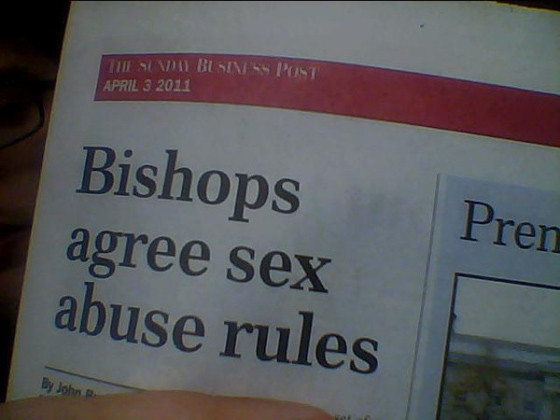
SBP Headline FAIL!!!

Taken from the Huffington Post, perhaps the most unfortunate headline ever.

Sunday, 3 April 2011

Quick Jabs 2

I've written another article for the fine website, thescore.ie this week. You should go there to read the snappy intro they've written for it, and all their other fine stuff. My merely adequate contribution is below.

+++

Despite two Irish fighters losing in fights for World Titles last month, 2011 may yet prove to be a successful year for our own with, it seems, another pair of World Title shots to look forward to.

Paul McCloskey is continuing his preparations for his fight against Amir Khan on April 16th, but one man who won’t be fighting on that card is Matthew Macklin. The Tipperary native was due to take on Khoren Gevor in an Eliminator fight for the WBA Middleweight Title at the MEN Arena that night, but has withdrawn with promoter Ricky Hatton citing ‘contractual issues’ in an interview on RTE Radio.


However, word on the grapevine is that the real reason for this decision is that Macklin is set to get a straight shot at a World Title, probably against WBA ‘Super’ Champion Felix Sturm. The German last fought in February, so a fight in the next two months would not be out of the question. Regular WBA Champion Gennady Golovkin and IBF Champion Sebastian Sylvester are also both regarded as options, but Sturm is the most likely opponent for the Tipperary native.

The fight is fraught with danger however. Macklin was initially due to fight Winky Wright in the US on April 9th, before the American was injured, and now that he has pulled out of the Gevor fight it means his training schedule, presumably aimed at peaking this month, will now have to be changed. Also, Sturm has never lost a decision in his homeland and if a fight is to be made with the German, it’s likely that Macklin will have to travel. He’d best work on his knockout punch...

+++

Speaking of judging decisions, it was interesting this week to read Katie Taylor tell The Score that boxing ‘is a corrupt sport at times.’ The statement is not news in itself, especially coming after Taylor’s recent shocking loss in Bulgaria, but it does serve to underline the difficulties facing Ireland’s amateur boxers ahead of the London Olympics.

For Taylor, there will be only one Qualifying event – the World Championships in China next May. Failure to progress to at least the Quarter Finals there, be it due to an off-day, a lucky punch or questionable judging will end any hopes the Bray woman has of winning an Olympic medal, long before the Games begin.

For Ireland’s men, the Qualifying process begins much sooner than that with this year’s World Championships in Azerbaijan in September. While not their only chance of reaching the London Games, it is one of the best for the Irish boxers who will continue to jockey for places on the team in tournaments in Finland and Poland next week.

+++

Two years ago, Kelly Pavlik was one of the hottest things in boxing. As a middleweight champion who had twice beaten Jermaine Taylor, the Youngstown native was likable, a big ticket seller, and always entertaining.


However, alcoholism and a staph infection almost halted his career, and Pavlik is to make his comeback in his first fight in over a year on the undercard of the Shane Mosley – Manny Pacquiao fight next month. Pavlik has moved up to the 168 pound division, and will take on the unbeaten Alfonso Lopez. The show is set to be a cracker –Humberto Soto is also due to take on Urbano Antillon in a rematch of one of the best fights of 2010.

+++

Congratulations to veteran promoter Bob Arum, who this week celebrates the forty-fifth anniversary of his first show. Arum has put on many of the most famous events in the sport’s history, including over 500 World Title fights. His Top Rank company are also going as strong as ever, and will put on the aforementioned Pacquiao-Mosley card on May 7th.

When asked about his career so far, the 79 year old said “It’s a good start.”

+++

Tributes have been paid to former broadcaster and trainer Gil Clancy. The Hall of Famer passed away at the age of 88 on Thursday. Best known for his work with Emile Griffith, Clancy also trained a host of champions and contenders before beginning a career on US TV in the 1980’s.

+++

This weekend is a fairly quiet one for boxing fans, though Setanta Ireland will have live coverage of Ivan Calderon’s bid to gain revenge over Giovani Segura in their WBO Light Flyweight Title fight from Mexico in the early hours of Sunday morning.

+++

This Week in Boxing History

This past Thursday marked the 21st anniversary of one of the finest nights in one of the most under-rated boxing careers. An all-action fighter, Terry Norris was exciting as anyone in the ring, particularly from 1988-1993. He was elected to the International Boxing Hall of Fame in 2005, after a career which saw him win four World Titles and the support of many hardcore fans. ‘Terrible’ Terry’s gung-ho style is best encapsulated in this devastating first round knockout of John Mugabi on March 31st, 1990. It was Ring Magazine’s Knockout of the Year.

Greys Off Key

My other half has impeccable taste.  She goes out with me.

She does, however, watch Greys Anatomy, something I don’t.  That said, it does be on over on the other side of the bed from time to time, including tonight.

This is a show which has had it’s moments, good ones I mean, but this week’s one was not.

I won’t say much, as I’m aware that the show is on RTE during the coming week, except to say that the episode Song Beneath The Song reminded me of two moments from TV’s past.


Sunday, 27 March 2011

Kids These Days

This is fantastic.

Picture is not related to the story, unsurprisingly.